
Blog · AI
AI Chatbot: 5 Examples to Transform the User Experience
On this page
Are your users abandoning your old bots? Discover how a bespoke AI chatbot can revolutionise the customer journey. Explore our 5 practical examples.
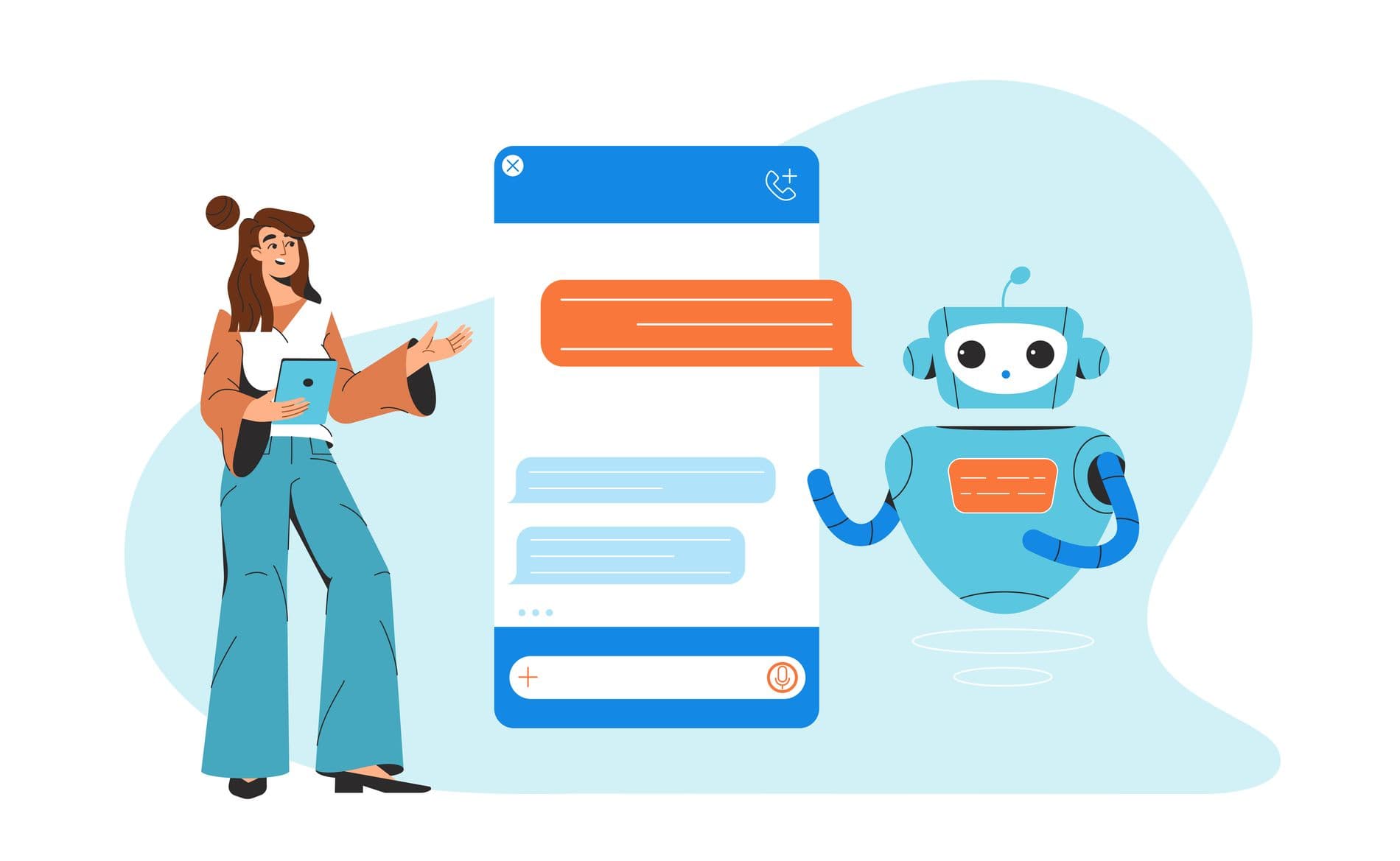
The word ‘chatbot’ once triggered real frustration among internet users. Users would endlessly loop through menus. Responses were often off the mark. Today, generative AI has completely reshaped the landscape. We’re no longer talking about simple pre-written scripts. We’re dealing with a true conversational agent capable of understanding and taking action.
Integrating a bespoke chatbot into your applications revolutionises the customer journey from start to finish. Companies no longer seek to impose a rigid path. They adapt the interface to each visitor’s immediate needs. This article shows you how to transform your digital product. We’ll explore each exampleAI chatbot to give you concrete application ideas.
From Frustrating Automaton to Intelligent Conversational Agent: A UX Revolution
It’s essential to understand where we came from to measure the progress made. Recent technological advancements have turned a simple gadget into a powerful business tool.
Why Old Models Drove Your Users Away
Previous generations of chatbots relied on strict rules. Developers built massive decision trees. The logic was binary. If the user clicked button A, display text B. The user experience suffered greatly. As soon as someone made a complex request or used synonyms, the system collapsed. The infamous error message stating the bot didn’t understand the question became a symbol of failing customer support. These technical limitations created friction and caused conversion rates to plummet.
The Advent of Language Models and Autonomous Systems
The arrival of large language models addressed this major issue. A well-mastered LLM integration enables the system to grasp the nuances of natural language. The programme understands context, intent, and even the user’s tone. The software shifts from a rigid automaton to a proactive virtual assistant. It no longer just reads a knowledge base. It generates unique, tailored responses. User engagement soars because people finally feel heard and understood.
5 AI Application Examples Reinventing the Customer Journey
Let’s now explore real-world use cases. These applications demonstrate how technology integrates at the heart of business processes to create value.
1. Self-Resolving Technical Support
Forget basic interactive FAQs. The new generation of automated customer service takes on an entirely new dimension. The system connects directly to your CRM or invoicing tool’s API. A customer wants a refund for a damaged package. The virtual agent analyses the request, checks the order status in the database, and asks for a photo of the product. It then analyses the image. If the conditions are met, it autonomously approves the refund. This level of customer support drastically reduces the workload for your teams while providing instant resolution for the buyer.
2. The Ultra-Personalised E-Commerce Advisor
The e-commerce sector demands a personalized customer journey to stand out. Traditional search filters quickly reach their limits when faced with specific queries. Imagine a visitor looking for running shoes. Instead of ticking boxes for size and color, they explain their needs to a virtual advisor. They specify they’re training for a marathon in the rain and tend to run on the balls of their feet. The program analyzes this rich context, cross-references it with a complex product catalog, and then suggests three precise models, explaining the benefits of each for this exact scenario.
3. Self-service data analytics for managers
This is a particularly powerful enterprise chatbot use case for the B2B sector. Analytical dashboards are often too complex for occasional users. You can integrate a conversational module directly into your business software. A sales director simply types a question into the search bar—for example, last quarter’s revenue for the southern region. The system translates this sentence into a complex SQL query, queries the database in real time, and generates a clear graph with a text summary. Data becomes accessible to everyone without prior technical training.
4. Logistics and resource planner
Managing schedules and routes involves multiple constraints. An autonomous agent excels in this type of complex environment. Take the example of a fleet management application. The manager asks the system to reorganize the next day’s deliveries following a driver’s absence. This is a custom generative AI application that goes far beyond simple text generation. The system coordinates several sub-programs: one calculates routes, another checks customer schedules, and the last optimizes fuel consumption. The result is a new, optimized schedule generated in seconds.
5. Interactive onboarding for complex software
SaaS platforms often suffer from high abandonment rates during the first login. Users get lost in dense interfaces. A virtual assistant advantageously replaces long video tutorials or austere documentation. It welcomes the new user and asks about their main goal for the day. Based on the response, the interactive guide highlights the right interface buttons and accompanies the person step by step through account setup. This approach transforms a tedious step into a smooth and reassuring experience.
Under the hood: Scroll’s method for your projects
Deploying these solutions requires genuine technical expertise. Simply connecting a basic API key is not enough. Custom chatbot development demands a robust architecture to ensure the reliability of responses.
Structuring application logic with LangChain and LangGraph
Creating an intelligent chatbot requires using the right orchestration tools. We use advanced frameworks like LangChain and LangGraph to structure the brain of your application. These technologies break the linearity of conversations. LangGraph enables the creation of reasoning cycles. The agent can thus verify its own work, correct a logical error, or request missing information before delivering its final answer. It’s this iterative capability that creates the illusion of true intelligence.
Ensuring information accuracy with RAG
The greatest risk with language models is hallucination. The program can invent facts with disconcerting confidence. To counter this, we implement a RAG architecture. This stands for Retrieval-Augmented Generation. In practice, we force the model to read exclusively your internal documents before formulating its response. The AI becomes an expert in your own product sheets, technical manuals, or internal procedures.
Ensuring data security and continuous integration
The confidentiality of your strategic information is an absolute priority. A custom generative AI application developed by our team ensures your data is never used to train public models. We set up secure, isolated environments and handle the seamless integration of these new technological components with your existing infrastructure. Your information system remains protected and high-performing.
3 fundamental principles for successful AI deployment
Technology alone is not enough to guarantee your project’s success. Strict usage rules must be followed to ensure end-user adoption.
The critical importance of a human safety net
Automation should never trap your customers. There must always be an elegant exit. If the system fails to understand a request or the situation requires empathy, the transition to a human operator must be immediate. The handover includes the full conversation history to prevent the user from repeating themselves.
Complete transparency about the system’s nature
It may be tempting to give your program a human name to make it more approachable. However, you must never mislead users about who—or what—they are interacting with. Clearly state from the first message that they are speaking with a virtual assistant powered by artificial intelligence. This honesty builds trust and allows people to naturally adapt how they phrase their requests.
Mastering latency times for seamless fluidity
Complex models sometimes take a few seconds to generate a full response. This delay can feel very long when faced with a frozen screen. We use interface design techniques to mask the wait. Progressive text display, word by word, keeps the reader engaged. Adding visual indicators that show the system is processing data reassures the user that their request is being handled.
What is an AI chatbot compared to a classic robot?
A classic robot follows a rigid script and blocks any unknown word. An AI chatbot uses a large language model to understand the context and nuances of a request. It generates unique responses instead of reciting pre-recorded text. This is the foundation for any high-performance, custom generative AI application.
How does a conversational agent actually improve the user experience?
The tool remembers the discussion history and asks clarifying questions. It creates a real-time, personalized customer journey. The user experience becomes fluid because the system adapts to the visitor’s vocabulary. This natural conversational approach significantly increases user engagement with your application.
Why use RAG for custom chatbot development?
Language models can sometimes produce inaccurate answers. RAG grounds the answers in your documents, making them more relevant and better suited to your business. Your chatbot can therefore draw on your catalog or procedures. Targeted checks strengthen the reliability of the answers and help maintain control over the information shared.
Is automated customer service a total replacement for human support?
The machine’s role is to instantly process repetitive and time-consuming requests. Your human teams can then focus on complex cases requiring empathy or negotiation. A well-designed integration project always includes a quick redirection to an operator in case of doubt. Technology and people work in synergy.
What technical tools ensure a successful enterprise chatbot use case?
Scroll agency uses highly advanced frameworks to structure the core of your application. We notably use LangChain to connect artificial intelligence with your secure databases. We then implement LangGraph to create reasoning loops, enabling the program to verify its own work. This custom architecture ensures optimal performance for your business processes.
Related articles
Jun 15, 2026
AI and legacy code: migrating and documenting existing systems
AI reads, explains, documents, and helps migrate legacy code—provided it’s properly supervised. Our approach: AI accelerates, engineering decides.
Jun 15, 2026
Open WebUI: the self-hosted interface for your LLMs
The open-source, self-hosted interface that brings the ChatGPT experience to your own models—local or cloud, with built-in RAG, under your control.
Jun 11, 2026
LangChain, LangGraph, LlamaIndex: Which Framework for Your AI?
LangChain for quick assembly, LangGraph for stateful agents, LlamaIndex for document RAG—or none at all. How to decide.